
A personalised gift for a loved one, a project of love crafted into footwear or an old tapestry found in a loft, a pair of tapestry slippers is a great addition to any shoe collection. We made this guide to help you take the next step once you are interested in a pair.
Where to start
Before starting we suggest you contact us first, either by email or by phone. Depending at what step you are at we can guide you what to do next. We would hate to receive a tapestry that isn’t fit for purpose and therefore have to send it back. Our email is info@broadlandslippers.co.uk
It is important to note that we make up your finished tapestries into slippers and don’t make the tapestry ourselves. We do however have our friend Sarah Barns, also from Norfolk, to assist in starting up. She can supply a canvas with a design of your choice, together with the wools, ready to be stitched. Or she can do the needlework for you (or complete a piece that has been started).
Paper Template
If you know the shoe size required we will provide a paper template of the tapestry we need and send it out to you in the post. If you do know the size needed then we can give guidance for measuring the correct size.
The template will show the certain margins needed in the production of the slipper. This means that some of the design will be lost at the edges to allow for the closing, binding and lasting processes. It is therefore important that when considering your design that any elements you want shown are in prominent central positions away from those edges. The front (vamp) is most visible whilst wearing and more favourable designs running along the side are best suitable to the outside quarters, rather than the inside.
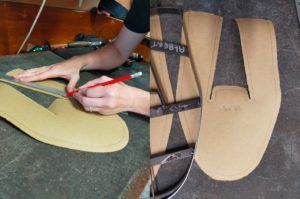
Cutting and marking out the margins by hand
Men’s templates are cut with a ‘straight’ pattern and are same for left and right foot prior to production. For ladies there is a distinct left and right foot, which will be labelled on the template. Regardless It is important to make us aware of which tapestry is for which foot as we don’t want to make mistakes or delay the production time.
Like with any of our other slippers, our tapestry pairs are available in a range of quilted and leather lining options, consider what colour will go best with your tapestry. We also have a range of binding options and can assist in matching colours best we can.
Production
Once we have received your tapestry we will check that it is suitable and if for any reason there is an issue we will let you know. Once we are happy to proceed we can begin production.
First a cotton backer is applied to the back of the template. This gives the tapestry the right thickness and strength for production as well as protecting it from the adhesives and starch solution used in the making process. During this time the tapestry is shaped to fit the pattern required, some tapestries come to us slightly warped after being made under tension, our aim is to correct that before cutting.
Once cut the tapestry goes through the usual process of shoemaking. The backs are closed and the lining is married with the upper and a binding is sewn on.
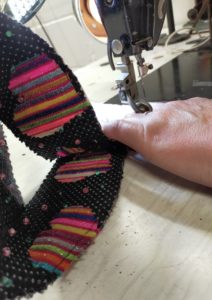
Stitching the backs of the tapestry together
Finally it is lasted by hand with a leather stiffener in the back for support. Once the adhesives have dried it is taken off the last and a matching insole sock is inserted. Then there are final checks and boxing it is ready for shipping. All of our slippers are sent by tracked signed for courier for safe delivery.
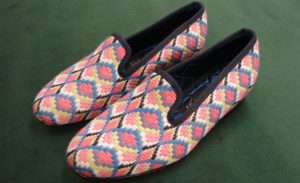
Finished slippers ready to be sent out
The concept of slippers fills our head with images of modern footwear, like the Uggs that ooze warmth and comfort. Interestingly, our traditional English slippers are taking the world by storm, being worn both in the house and outdoors. However, this iconic shoe isn’t a new trend. Indeed, the first pair were made and worn in the 1840s. Slippers themselves have a wealth of history behind them, the name slipper derives from the Old English language from the words “sliper” and “slipor” which mean “slip-shoe”. As described by Dr. Samuel Johnson: “A shoe without a leather behind, into which the foot slips easily.” Let’s summarise the extensive timeline of slippers and how they’ve become what they are today.
The First Pair of Slippers
Slippers are the oldest style of shoe in history, dating back to prehistoric times. The oldest surviving pair of shoes that have been found are slippers and are predicted to have been worn 10,000 years ago. This particular pair of slippers were made from woven fabric with a folded pocket to protect the toes of those wearing them and were strapped to the foot with a thong due to the lack of structure.
Babouche
Babouche is an adaptation of the Arabic word “babush” and the shoes were produced during the Cradle of Civilisation. They were described as slipper-like with an exaggerated point for the toe. This design was intended to highlight that the wearer cared about their lifestyle and appearance. As well as being worn for their unique aesthetics, Babouches are known for their extreme comfort due to the repetitive cleaning and drying process carried out when these slippers are made, making them an even more appealing fashion piece. Fashion and lifestyle magazine Vogue announced Babouches as the must-have shoe in 2016, and up to this day, traditional Babouches are still being made and worn in Morocco.
No Shoes to be Worn on Holy Ground
Originally, it was viewed as inappropriate to wear shoes on holy ground, with many people removing shoes before entering a place of worship – this is a sign of respect and is symbolic of detaching oneself from the materialistic world. The only exception to this rule is seen in some parts of India where both the priests and those who work in holy places are permitted to wear wooden slippers.
Cultural views
For some cultures, specifically the Middle East, displaying bare feet in front of others is considered offensive. The sole of your foot is viewed as dirty and the lowest part of your body, therefore, it shouldn’t be on display in front of others. However, the same views are held for shoes and are expected to be removed as a sign of respect, especially when entering someone’s home. The Koreans and Japanese opt to hide their feet with slippers and socks, also known as “sil nae hwa” which is translated into “room indoor shoes”.
Pantofles
This style of slipper is the most extravagant; clog-like shoes that predominantly support the forefoot but are similarly lightweight and backless like most slippers. The term pantofles became a household name, particularly in France where it became a fashionable slip-on shoe. The most famous pair of pantofles to this date are those worn by the highly recognised Disney princess, Cinderella and her glass slipper (pantofle).
Prince Albert Slipper
Lastly, of course, we had to mention our Prince Albert slippers. After various styles of slipper before these, the Prince Albert trend began in the Victorian period and is still hugely popular today. This style of slipper was formalised to be worn outside when Prince Albert would attend black tie dinner events wearing them. Following this, they were often seen being worn by men outside the house to clubs and smoking rooms. Still to this day, Prince Albert slippers are worn to black-tie events, red carpets, and in clubs.
The History of SlippersAt one point, the Prince Albert slipper was only worn by those with a specific status and wealth. They were the preserve of those who used their dress to impress, and those with the necessary income to indulge in a few extravagances. However, nowadays, this style of shoe has been embraced by a completely new audience and the lines between target markets have become slightly blurred.
The original wearer and trend setter himself, Prince Albert (a well-respected consort of Queen Elizabeth) began wearing his English slippers to black-tie events and since then, it was common for gentlemen of a specific calibre to wear these to clubs and in smoking rooms. Some members of the royal family still wear the Prince Albert slippers today. Prince William, for example, was recently seen sporting this style of shoe to the BAFTAs with his wife, the Duchess of Cambridge.
On top of royalty, there’s a massive range of male celebrities who have warmed to the trend. Starting with the ideal and traditional gentlemen; Stephen Fry, Eddie Redmayne, Robert De Niro and Michael Caine have all been photographed wearing the shoe. However, a new generation have stepped forward, adopting the style and adapting it to fit in with their own; Kanye West, Scott Disick, Ryan Gosling, Kit Harrington, Spencer Matthews and Snoop Dog.
With everywhere from the red carpet to the studio being an appropriate place for the Prince Albert slipper, it’s clear that the trend is vey much alive and well. Undoubtedly a timeless piece in fashion, there is no fear that the Prince Albert slipper will ever fall out favour amongst the discerning shoe wearer.
Prince Albert Slippers: Worn by Audiences of All Ages & Styles